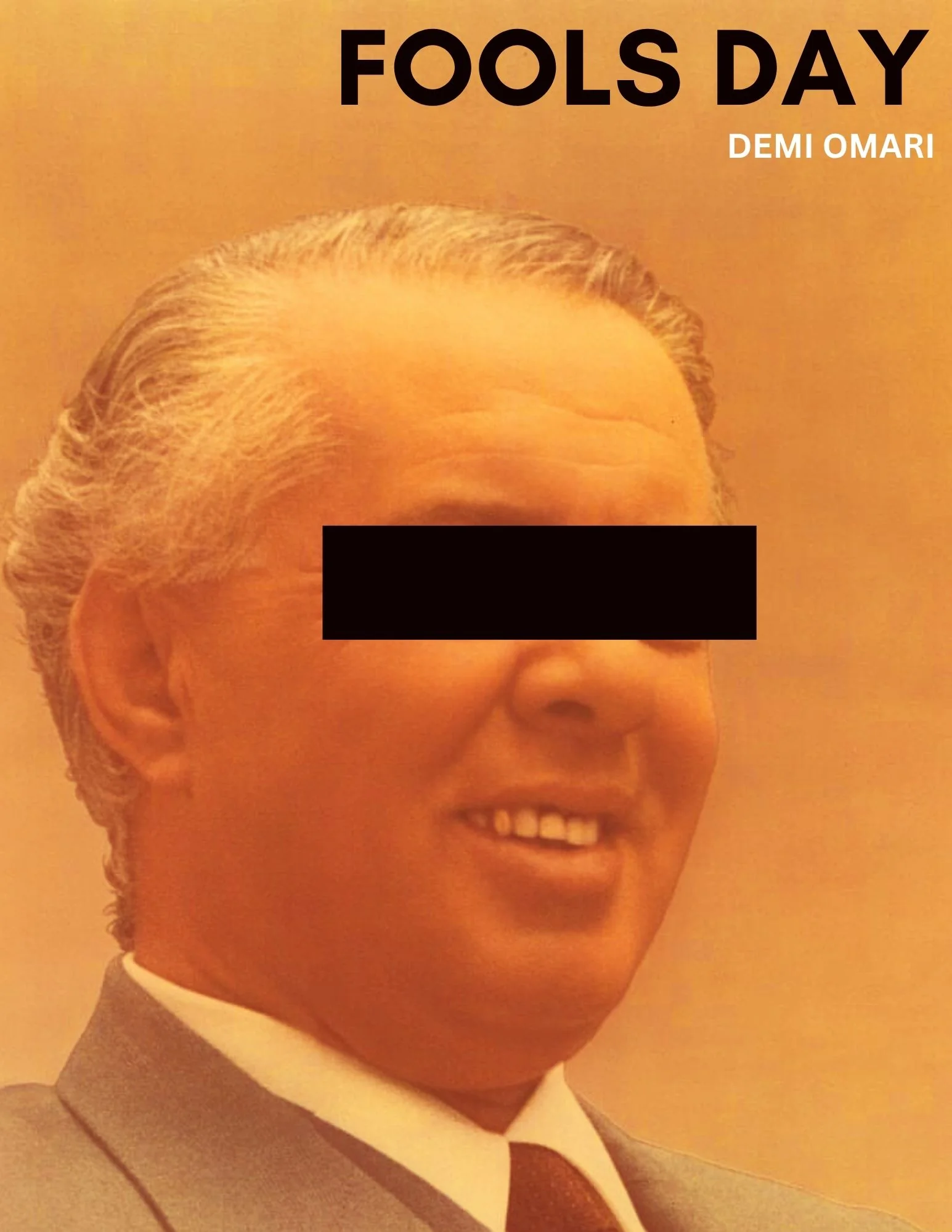
Fools Day · Chapter 1
Chapter 1
Of Birds and Predators
06:38 April 1, 198_
1.
Petrit’s filterless Partizani cigarette hung in the balance of terror and disbelief between his mauve lips. Right at the corner, where there was a bit more grip, pointing at his canines, already jaundiced by years of reticence. A man like him didn’t need a mouth, just a corner of a mouth. No words were allowed to escape, and he already had too many wide-open mouths to feed. His deep, sunken eyes said enough, noticed too much. A hawk’s eyes. But now his eyes had joined his mouth. Useless. He couldn’t believe anything they read.
His arms had thinned out with the years, the veins visibly blue under thick, syringe-proof skin. Whatever he lacked in heft, his hands made up for in character. Bony, hairy, claw-like with a walnut-breaking grip. Yet shaking. Trembling like a leaf of paper. Not the one in his hand. That one held solemnly still, emboldened in thick scarlet lettering, “Fletërrufe,” lightning sheet, below it the name to be libeled, his own, in black.
The fletërrufe smelled like the wall. Rigid, complacently waiting for the bullets of the firing squad. That sheet of paper was a map to a treasured chest. His own. X marked the mortal blow.
He took a deep breath through his cigarette. No coffee. Black tea. A piece of brownish bread. Mortifying terror. His breakfast today.
Logic would say, “Many have come back from a fletërrufe. Tomorrow is another day.” Years as an employee of Sigurimi i Shtetit said, “Fucked!”
His gut said, “Run.” Which meant death. Closed doors. Closed borders. Crossing into Greece, suicidal unless you were a local shepherd. Yugoslavia, worse. The best way out was to swim through a well-patrolled lake on a moonless night. Chances of survival, slimmer than his ass. His family, food for the wolves.
He was not a smart man. Just regime-wise. He had survived since day one. Liberation war. Civil war. Interparty Yugoslav War. Interparty Soviet War. Comrade Commissar! Don’t think. Follow orders. Say nothing. Take a hint or take a hike. He was not a smart, educated man. That’s why he was still alive.
But now he was dead. And he was smart enough to know it. If the accusations were true, he might survive. But unfortunately they weren’t. The fletërrufe was clear, in a country where truth hid between the lines. Apparently a young little thing was turning the screw. “…and after he pinned me against the inner wall of the Ministry of the Interior, he had his way with me from behind. He muffled me with a claw-like grip. I couldn’t scream.” Signed, Zana K.
He jerked his head, as if to wake up. A Fools’ Day joke? Petrit didn’t sleep around. He had lost the taste. Murder can drain. Murdering under orders, while living in terror that you might be next. Now that will un-sperm you. Life can never flow from you again. You become a living death.
Filterless Partizani. No coffee. Black tea. Brownish bread. Another dead in black and white on page 2. His breakfast each day. So life had gone by. See everything. Say nothing. Now his turn to become nothing.
2.
The Ministry of the Interior of the People’s Socialist Republic of Albania, Land of the Eagles, stood on the corner of an imposing quad of fascist architecture. Like old churches long converted into mosques, the palazzo had become a People’s communist temple of serenity. The Italians had built it during a prolonged courtship, which was followed dutifully by a well-choreographed invasion. To the surprise of exactly no one, the Italians proved inept colonizers. A colossal investment in infrastructure, architecture, and buon gusto was but a highway to disastrous defeat at the hands of the Greek Army. In their retreat, they abandoned armies of the dead, and the quad, a grotesque neoclassical jewel set in the indigent twelfth century.
If poverty is a temporal condition in space, indigence is an inescapable hereditary disorder. It drains the soul of a people generation by generation. It is suffering to the point where there is no life but suffering. This was the Buddhism of penury. All one could hope for was to survive long enough to see most others succumb. Stuck in this historical rut, the quad was abandoned, buon gusto for men hardened by millennia of indigence.
The fletërrufe was meticulously plastered over the red bricks right by the six-meter-high door of the secondary entrance to the Ministry, as if the true author wanted to give away his address. This was not a common place to vent grievances. The plebeian class, now named the proletariat, wouldn’t dare stop by. Instinctively, Petrit had ripped it away to uphold order, cleanliness, decency. Only once he had passed the guards, who were intently studying their boots, and stepped into the ornate, dimly lit hall, did he notice his name written in dangerously curved calligraphy. He raised his head, as if searching for God. The enormous painting of Enver Hoxha amicably stared back with his mystic Mona Lisa smile, nudging forward, “Go ahead, my friend, step on up.” Petrit’s office was on the third floor.
There was no elevator to the gallows. The marble on the winding staircases to the Directorate of Internal Security had gone soft with the years. When imported from Italy, after much thoughtful consideration, the marble had shone with sophistication, with what seemed like effeminate intellectual tenacity to the hard men stepping on it. But fine marble can bear only so much torture. Each body dragged up the stairs from the basement to sign a confession had softened it. Bloody hands and kicking legs had taken a toll on the stairwell’s ornate balustrade. The marble’s white veins had disappeared, stained bloody red.
Petrit remembered the first time he had gone up these steps. Right after the war. Amid chaos. Murder in plain sight. The beautiful hall was divinely lit. Unlike his village hut. “Now there will be equality,” he thought. “All houses will be so lit.” His generation’s sacrifices would finally pay off. The road to hell, he would learn, can also be paved with sacrifices. He went up the stairs pensively, looking up with each step, like that very first time, on the lookout for a hidden enemy. Would this be the last time he dragged himself up these steps on his own?
The tall walnut door stood inches from his nose, breathing in his fear, repelling the moisture of his breath. The key struggled its way through the lock, Petrit’s eyes closed. When he opened them, his desk was still there, cluttered with dossiers, pristinely chaotic. The spines of the files were still aligned just as he had painstakingly placed them the night before. A constellation of dossiers set like the stars of Gemini. Untouched. A good omen, he thought.
He sat down and caressed the wooden armrests. Should he have pampered his children a bit more? That chair had taken so much of his time, and now it was about to take his life. He clenched his fists. This was no time to wax sentimental about the past. His life was on the line, and with it the future of his family.
His legs started shaking. His brain would take no respite; fear had taken over. Flight was not an option, hence… But how could he fight this? Who was he fighting? Who was Zana K., and more importantly, who was behind her? It had never been him.
It was useless to think of the enemies he had made over the years. The regime’s logic had percolated down; everyone could be the enemy. Friends were far more dangerous than enemies. One look at the dossiers in front of him would explain why. Your friends would dig your grave with their pens; some would be forced to collaborate, many would judiciously volunteer. Put you in a dossier, toss a few tearful flowers after you while the undertaker files you away for eternity.
Precisely why he had no real friends. Only acquaintances tacitly cultivated for decades. Speak to no one. Whenever possible, interrogate whoever you spend time with. That way they don’t have the leisure to start spinning tales about your silence. That way they don’t try to find out whatever it is that only you know you are not hiding. The way of silence.
2,919,713 citizens, 47% under 19. 1,223 Sigurimi agents, 9,239 informants. Collaborators? Anyone.
"Searching for Zana K. would be daunting; discovering her cher ami would be painful — for her. Yes, he would have to find her before the new moon. Bring her in for a conversation, remind her of her kin, find out who had sweetened her pot, crack the knuckles. She would eventually talk. They always talked once under his claws. The wooden armrests screeched in pain.
Comrade Hekuran must not hear of this! Unless, well, unless he was behind her to begin with. Comrade Hekuran liked getting behind pretty young things. Nah, he wouldn’t be sitting at this desk if Comrade Hekuran were the cher ami.
Petrit knew how the Comrade went about his hunts. Comrade Hekuran was an early bird. A GAZ-69 would have swooped and intercepted the children on their way to school or work. Packed the younger ones in the back. The eldest one up front. Treat him kindly before showing him his traitor father. Work them while they are young. Would have driven them past the window of the interrogation room, Petrit raked by talons. At that point he would have signed his confession, named names, bloody quill still in hand. Out of comradeship, they might even have told him what the judge’s verdict would be.
Yet here he was, still sitting in his office; they hadn’t pounced and crippled him. If it wasn’t the Comrade, there was still a chance he could fight this! It could be a fledgling, learning to fly. Someone aiming for his place in the pecking order. Think hard.
Time to act. Contain. Take down as many of these fletërrufe as he could find. Investigate. Sniff around the archives for this Zana K. Apprehend. A black sack would calm her down. Talk to her calmly, fatherly. Explain the dangers. Cover the room in smoke. If she don’t sing, dig his blackened thick nails in and gouge her predator eyes clean off her skull. Clean up.
His old pack of Partizani cigarettes was empty. He got up, opened the drawer, and picked up a new one, together with his Tokarev TT-33. Patted down his pockets as if searching for courage and whispered:
“First things first. Take them all down!”
Sigurimi i Shtetit
End of Chapter 1
About Fools Day
Fools Day is a novel by Demi Omari set in communist Albania. Chapter 1, Of Birds and Predators, opens at 06:38 on April 1 in the 1980s. Petrit, a veteran officer of the Sigurimi i Shtetit, Albania’s state security police, finds a fletërrufe, a “lightning sheet” of public denunciation, pasted beside a side entrance of the Ministry of the Interior in Tirana with his own name on it. The accusation is false, and he knows exactly what such a sheet can do to a man and his family.
Over one morning in his office he weighs flight against fight, reckons friends more dangerous than enemies, and resolves to find the woman who signed it before the new moon. The chapter types itself out on this page like a typewritten file and closes on the emblem of the Sigurimi.
For photographs of Tirana today, see Houseless.